
Manx vs. Cymric Cat: What’s the Real Difference?
Quick Facts
| Manx | Cymric |
| Short-haired | Long-haired (same breed, different coat length) |
| Origin: Isle of Man | Origin: Isle of Man (longhair gene surfaced in North American breeding lines) |
| Dense, double coat, plush texture | Medium-long coat, soft, ruff at the neck, “britches” on hind legs |
| Recognized as its own breed by some registries | Recognized as a Manx variant by others (varies by registry — CFA lists Cymric as a separate breed, TICA treats it as a Manx longhair division) |
| Same taillessness range: rumpy, rumpy riser, stumpy, longy | Same taillessness range: rumpy, rumpy riser, stumpy, longy |
| Same “Manx syndrome” health consideration | Same “Manx syndrome” health consideration |
Are Manx and Cymric Cats the Same Breed?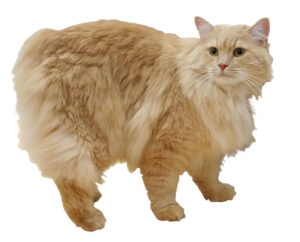
Genetically, yes. The Cymric is a longhaired Manx — the same tailless mutation, the same body type, the same rolling gait, just carrying a longhair gene that shorthaired Manx cats don’t express. Litters from Manx parents can produce both coat lengths if both parents carry the longhair gene recessively, so it’s entirely possible for a Manx and a Cymric to be littermates.
Photo: “Cymric Fond Blanc” by Desaix83, d’après le travail d’Heikki Siltala, CC BY 3.0, via Wikimedia Commons.
Where things get confusing is registry classification. Some organizations, like the Cat Fanciers’ Association, register the Cymric as its own breed with its own standard. Others, including The International Cat Association, treat it as a coat-length division within the Manx breed itself rather than a separate breed. Neither approach is “wrong” — it’s just a difference in how each registry chooses to organize coat variation.
Coat Differences, Side by Side
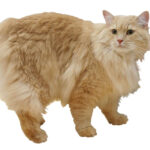
The most obvious difference is visual. A Manx has a short, dense double coat that lies close to the body, giving it a plush, rounded look. A Cymric has medium-to-long fur, typically with a visible ruff around the neck and britches (longer fur) on the hind legs and belly, similar in feel to a Maine Coon’s coat but on a smaller-bodied cat.
Grooming needs differ accordingly. Manx cats need minimal brushing — a weekly pass is usually plenty. Cymric cats need more frequent brushing, especially around the ruff and britches, to prevent matting.
Temperament: Any Real Differences?
No meaningful temperament differences exist between the two — coat length doesn’t change personality. Both are typically described as loyal, dog-like, food-motivated, and good with families, since they share the same underlying breed temperament. Any personality variation you’ll see comes down to the individual cat, not whether it’s short- or long-haired.
Health Considerations Are Identical
Because Cymric cats carry the exact same tailless mutation as Manx cats, they carry the same risk of Manx syndrome — a spinal condition that can affect cats with the most extreme taillessness (true “rumpies”). Reputable breeders screen for this regardless of coat length. For a full breakdown of symptoms and what to watch for, see our Manx syndrome guide.
Which One Is Right for You?
The choice mostly comes down to grooming tolerance and coat preference, not breed traits. If you want the classic short, plush Manx look with low grooming upkeep, a shorthaired Manx is the simpler choice. If you like a fluffier coat and don’t mind regular brushing, a Cymric offers the same personality and body type with more visual flair.
Frequently Asked Questions
Is a Cymric just a long-haired Manx?
Yes. The Cymric is genetically a Manx with a longhair gene — same body type, same taillessness range, different coat length.
Can a Manx litter produce both Manx and Cymric kittens?
Yes, if both parents carry the recessive longhair gene, a single litter can include both shorthaired Manx and longhaired Cymric kittens.
Do Cymric cats have the same health risks as Manx cats?
Yes. Cymric cats carry the same taillessness mutation, which means the same risk of Manx syndrome in cats with the most extreme tail reduction.
Is the Cymric recognized as its own breed?
It depends on the registry. Some, like CFA, register it as a separate breed. Others, like TICA, classify it as a longhaired division of the Manx breed.
2 Responses to Manx vs. Cymric Cat: What’s the Real Difference?