
Lykoi Cat Origin: The Real Story Behind the “Werewolf Cat
Quick Facts
| Discovered | 2010, in feral cat populations in the U.S. |
| Key Locations | Vonore, Tennessee, and a separate discovery in Virginia |
| Founders | Johnny and Brittney Gobble, alongside breeder Patti Thomas |
| Genetic Testing | Conducted by geneticists at UC Davis and dermatologists at the University of Tennessee |
| TICA Recognition | Registered in 2011, granted Championship status in the years following |
| Not Related To | Sphynx cats — a completely separate genetic mutation |
A Breed That Started With a Question, Not a Plan
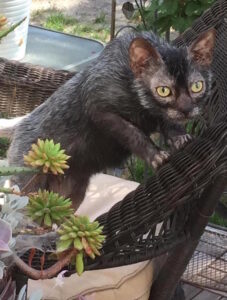 Unlike most cat breeds, which are the product of deliberate breeding programs built around an existing trait, the Lykoi began with something closer to a mystery. In 2010, a small number of unusually patchy, partially hairless kittens turned up in feral cat populations — one group in Vonore, Tennessee, and a second, unrelated group in Virginia. Nobody had bred for this look. It simply appeared, the way naturally occurring mutations sometimes do, and the people who found these cats had no way of knowing at first whether they were looking at a health problem, a skin condition, or something else entirely.
Photo: “8-month-old male Lykoi” by steptacular, CC BY-SA 4.0, via Wikimedia Commons.
Ruling Out the Obvious Explanations First
Before anyone could call this a new breed, it had to be ruled out as something else. Veterinarian Johnny Gobble and his wife, Brittney, took an early interest in the cats and worked with outside experts to figure out what was actually going on. Geneticists at UC Davis and dermatologists at the University of Tennessee tested the cats’ DNA, skin, and general health. The goal wasn’t to prove these cats were special — it was to make sure the unusual coat wasn’t a sign of poor health, a parasite issue, or an existing condition being mistaken for something new.
What the testing confirmed was that this was a distinct, naturally occurring genetic mutation — not related to Sphynx hairlessness, not a health defect, and not present in either parent cat’s known lineage in a way that suggested inbreeding or an unhealthy population. That distinction mattered enormously for what came next, since it meant there was a legitimate foundation to build a breed on, rather than something that needed to be bred away from.
From Feral Cats to a Founding Litter
With the mutation confirmed as naturally occurring and unrelated to any known health issue, the Gobbles began working to establish a breeding program. Rather than crossing the trait into an already-hairless breed like the Sphynx — which would have blended two different mutations together and made the genetics harder to track — they chose to work with the mutation on its own terms, breeding affected cats with unrelated domestic shorthairs to study how the trait was inherited.
The first litter specifically bred to establish the line arrived in 2011. That litter, along with the original founding cats, became the genetic foundation for essentially the entire Lykoi population that exists today — which is part of why the breed remains so rare. Every registered Lykoi traces back to a very small number of founding cats from just over a decade ago.
Getting the Breed Recognized
Discovering an unusual cat is one thing; getting a major registry to recognize it as an official breed is another. The Gobbles registered the foundation cats with The International Cat Association (TICA) in 2011, and worked through TICA’s standard multi-stage recognition process — starting with a “New Breed” status and building toward full Championship recognition as more litters were produced, more health data was gathered, and a consistent breed standard was documented.
The Cat Fanciers’ Association (CFA) followed with its own breed standard as well, treating the Lykoi similarly to how it had accepted other naturally occurring mutations in the past — evaluating it as a distinct, spontaneous trait rather than something engineered through selective crossbreeding.
Why the Timeline Matters
Understanding how recent this all is helps explain a few things about the breed today. The Lykoi is still a genuinely rare cat — the founding gene pool is small, breeders are still relatively few, and health data continues to accumulate as more generations are born and studied. This is also why reputable Lykoi breeders tend to be especially transparent and research-oriented; the breed’s entire history is recent enough that many of the people who discovered it are still actively involved in breeding and refining it today.
Frequently Asked Questions
When was the Lykoi cat breed discovered?
The distinctive mutation was first identified in feral cat populations in 2010, with the first deliberately bred litter arriving in 2011.
Who founded the Lykoi breed?
Veterinarian Johnny Gobble and his wife, Brittney, are widely credited as the primary founders, working alongside breeder Patti Thomas and outside genetic researchers to establish the breed.
Is the Lykoi related to the Sphynx cat?
No. Despite both breeds having reduced hair coverage, the Lykoi’s mutation is genetically distinct from the one responsible for Sphynx hairlessness.
Why is the Lykoi considered a rare breed?
Because the entire registered population descends from a very small number of founding cats discovered just over a decade ago, the gene pool — and the number of breeders working with it — remains limited.
Disclaimer: This article is for general informational purposes only. Historical details reflect commonly reported accounts of the breed’s development at the time of writing.