
The Lykoi Cat: Meet the “Werewolf Cat” Breed
Quick Facts
| Nickname | “Werewolf cat,” due to its partial hairlessness and roan-like coat pattern |
| Origin | Natural genetic mutation, first identified in feral cats in the U.S. (Louisiana and Tennessee) around 2010 |
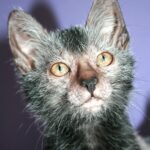
| Coat | Sparse, patchy black-and-white “roan” coat; some areas fully bald, especially around the face |
| Recognized by | TICA (as of 2012) |
| Temperament | Highly active, intelligent, dog-like, strongly bonds with people |
A Genuinely Recent Breed
Unlike most breeds on this site, the Lykoi doesn’t have centuries of history behind it — it’s one of the newest recognized cat breeds, developed from a spontaneous natural mutation first identified in feral domestic cats around 2010. Breeders worked with the mutation (rather than crossing it with an existing hairless breed like the Sphynx) to establish it as a distinct breed, and TICA formally recognized it in 2012 — making the Lykoi younger than many of its owners.
Why It’s Called the “Werewolf Cat”
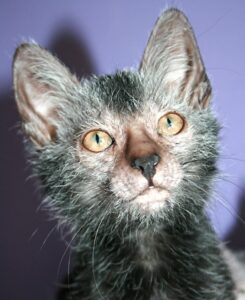 The Lykoi’s defining trait is its sparse, patchy coat — a genetic mutation affects hair follicle production, leaving areas of the body with little to no fur, especially around the face, ears, and legs. The remaining fur has a distinctive “roan” pattern — a mix of black and white hairs that gives the coat a salt-and-pepper, almost werewolf-like appearance, which is where the name comes from (Lykoi is Greek for “wolf”).
Photo: “Dea Chiara De La Vallée Des Dieux” by Christine Auverdin Boulanger, CC BY-SA 4.0, via Wikimedia Commons.
Coat Changes Throughout Their Life
Unlike most breeds, a Lykoi’s coat isn’t static — many individuals go through cycles of shedding and regrowing patches of fur throughout their life, sometimes triggered by seasonal changes, hormonal shifts, or stress. It’s normal for a Lykoi to look noticeably different from month to month or year to year, which can catch new owners off guard if they’re not expecting it.
Temperament: More Dog Than Cat
Lykoi owners frequently describe the breed as unusually dog-like — highly active, food-motivated, easily trainable, and deeply bonded to their people. They tend to follow owners from room to room, are generally good hunters (even indoors, targeting toys with real intensity), and are known for being intelligent problem-solvers. This isn’t a breed suited to being left alone for long stretches with nothing to do.
Care Considerations
Because of their sparse coat, Lykoi cats have less natural insulation and sun protection than most breeds. They can be more sensitive to cold temperatures and may need extra warmth in cooler climates, as well as some protection from direct sun exposure. Their skin also may need more attention than a fully-coated cat’s, since there’s less fur to help manage natural oils.
Frequently Asked Questions
Are Lykoi cats hairless like Sphynx cats?
No — Lykoi cats have a genuinely different genetic mutation than Sphynx cats and are only partially hairless, with a patchy roan-colored coat rather than being fully bald.
Is the Lykoi coat pattern permanent?
Not necessarily. Many Lykoi cats go through cycles of shedding and regrowing coat patches throughout their life, so their appearance can change noticeably over time.
Are Lykoi cats hypoallergenic?
No cat breed is truly hypoallergenic, including Lykoi. Their sparse coat may reduce visible shedding for some owners, but they still produce the Fel d 1 protein responsible for most cat allergies.
Do Lykoi cats need special care because of their coat?
Yes — their reduced fur coverage means they can be more sensitive to cold and sun exposure than fully-coated breeds, and some owners provide extra warmth or limit direct sun exposure as a precaution.
Disclaimer: This article is for general informational purposes only and is not veterinary advice. Consult a licensed veterinarian for guidance specific to any cat’s skin or coat health.
Recommended Reading
Manx Syndrome in Cats: Causes, Symptoms & What Every Owner Should Know
Munchkin Cat Health: Common Issues & What to Watch For
Lykoi Cat Adoption: Where to Find Breeders, Rescues & Kittens
5 Stunning Exotic Cat Breeds You Didn’t Know Existed
4 Responses to The Lykoi Cat: Meet the “Werewolf Cat” Breed