
Toyger Cat: Meet the Breed Bred to Look Like a Tiger
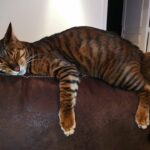
Quick Facts
| Origin | United States, developed starting in the 1980s |
| Founder | Judy Sugden, who deliberately bred for a tiger-like appearance |
| Coat | Short, dense, with bold vertical tiger-like stripes |
| Temperament | Confident, affectionate, intelligent, trainable |
| Recognized by | TICA |
| Lifespan | Typically 10–15 years |
A Breed Designed, Not Discovered
Unlike many of the unusual-looking breeds on this site — the Manx, the Lykoi — whose defining traits arose from spontaneous natural mutations, the Toyger is different in an important way: it was deliberately designed. Starting in the 1980s, breeder Judy Sugden set out with a specific goal in mind — to create a domestic cat whose markings closely resembled a tiger’s, partly as a way to draw attention to tiger conservation in the wild.
This makes the Toyger’s story less about a mutation being discovered and more about a decades-long selective breeding project, carefully working toward a very specific visual target while keeping the breed a genuine domestic cat in temperament and care needs.
Building the Stripes: How the Look Was Achieved
Getting a domestic cat’s tabby markings to resemble a tiger’s bold, vertical stripes wasn’t a quick process. Sugden worked with a striped domestic shorthair with unusually circular facial markings as a foundation, and later incorporated a street cat from Kashmir, India, whose markings contributed 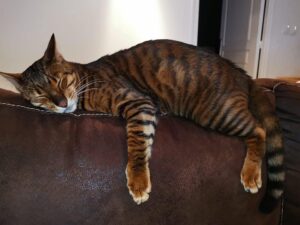 additional traits useful for the project’s goal. Over multiple generations, breeders selected specifically for stripe boldness, pattern clarity, and the closed, circular facial markings around the eyes that many people associate with big cats.
Photo: “Olaf Toyger Bellille” by Bellille, CC BY-SA 4.0, via Wikimedia Commons.
The result is a coat pattern meaningfully bolder and more defined than a standard tabby’s — vertical, well-separated stripes rather than the swirled or broken patterns typical of most tabby cats.
Not Actually Related to Tigers
It’s worth being direct about this, since the name invites the question: Toygers are not part-tiger, and there’s no wild cat ancestry involved in the breed. Every trait comes from selective breeding within domestic cat populations. The resemblance is purely the product of choosing for specific coat markings over many generations — the same general principle behind any purpose-bred physical trait in domestic animals, just aimed at a strikingly different visual outcome.
Temperament: A Genuinely Easygoing Cat
Despite the wild-cat look, Toygers are described by owners and breeders as confident, people-oriented, and notably trainable — often responsive to leash-walking or simple tricks with consistent positive reinforcement, more so than many breeds. They tend to be curious and playful without being especially high-strung, and generally adapt well to households with children or other pets when introduced properly.
Care and Grooming
Toygers have a short, dense coat that’s low-maintenance compared to long-haired breeds — regular weekly brushing is generally sufficient to keep the coat healthy and reduce shedding. Beyond coat care, Toygers don’t have any breed-specific health quirks tied to their striking appearance the way some purpose-bred traits do in other breeds; standard feline wellness care applies.
Why the Breed Still Feels Rare
Because the Toyger is a relatively young, deliberately developed breed with a specific, exacting visual standard, the number of breeders working with true, well-marked Toyger lines remains fairly small compared to long-established breeds. Finding a well-bred Toyger with strong stripe definition and TICA-registered lineage often means seeking out a dedicated breeder rather than expecting wide availability.
Frequently Asked Questions
Is a Toyger part tiger?
No. Toygers are entirely domestic cats with no wild cat ancestry — the tiger-like appearance comes purely from decades of selective breeding for specific coat markings.
Who created the Toyger breed?
Breeder Judy Sugden began developing the Toyger in the 1980s, aiming to create a domestic cat with tiger-like markings partly to raise awareness for tiger conservation.
Are Toygers good with families?
Yes, Toygers are generally described as confident, affectionate, and adaptable, often doing well with children and other pets.
Do Toygers require special grooming?
No. Their short, dense coat requires only routine weekly brushing, similar to most short-haired breeds.
Disclaimer: This article is for general informational purposes only. Historical details reflect commonly reported accounts of the breed’s development at the time of writing.