
Toyger vs. Bengal Cat: How to Tell Them Apart at a Glance
New to the breed? Start with our complete guide to the Toyger cat, covering origin, appearance and care.
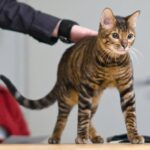
The quickest way to tell a Toyger from a Bengal is the coat: a Toyger has vertical tiger stripes, and a Bengal has spots, rosettes or a marbled swirl.
The two breeds are often confused, even on stock photo sites, because they share a warm golden coat, an athletic build and a deliberately wild look. This guide compares them side by side.
Toyger vs. Bengal: Quick Comparison
| Feature | Toyger | Bengal |
| Coat pattern | Bold vertical stripes, like a tiger | Spots, rosettes or marbled swirls, like a leopard |
| Colors | Brown striped only | Brown, snow and silver |
| Origin | United States, 1980s | United States, 1960s to 1980s |
| Wild ancestry | No direct wild cross; a Bengal was used in the foundation | Descends from the Asian Leopard Cat |
| Typical weight | Roughly 7 to 15 pounds | Roughly 8 to 15 pounds |
| Energy level | Active and playful | Very active and vocal |
| How common | Rare, with few breeders | Common and widely bred |
The Fastest Way to Tell Them Apart: The Pattern
Pattern is the most reliable difference, and it holds almost every time.
- Toyger: Dark stripes that run vertically down the sides, from the spine toward the belly. The stripes are bold, often branched or broken, and wrap around the legs and tail in rings.
- Bengal: Spots or rosettes scattered across the body. A rosette is a spot with a darker outline and a lighter center. Some Bengals have a marbled coat with wide horizontal swirls.
If the markings run up and down in lines, you are almost certainly looking at a Toyger. If they are round, scattered or swirled, it is a Bengal.
Look at the face as well. A Toyger is bred to have circular markings around the head, like a tiger’s. A Bengal’s face has finer lines and spots.
Is the Glitter Coat a Reliable Clue?
Many Bengals have a coat that sparkles in sunlight, as if dusted with gold. Breeders call this glitter, and it is one of the best-known Bengal traits.
It is not a sure way to tell the breeds apart. Because a Bengal was part of the Toyger’s foundation, some Toygers show glitter too. Treat it as a hint and rely on the pattern.
Where Each Breed Came From
The Bengal came first. Breeder Jean Mill crossed domestic cats with the Asian Leopard Cat, a small wild species, beginning in the 1960s. Today’s pet Bengals are many generations removed from that cross and are fully domestic cats.
The Toyger was created in the 1980s by Judy Sugden, who is Jean Mill’s daughter. She set out to breed a house cat with the look of a tiger, and her foundation cats were a striped domestic shorthair and a Bengal.
So the two breeds are related. The Toyger was developed without any new wild crosses, but it carries a small share of Bengal ancestry from its earliest generations.
Both breeds are recognized by The International Cat Association (TICA).
Size and Build
The two are close in size. Both are medium to large cats with long, muscular bodies, and males are noticeably bigger than females.
The difference is in the shape. A Toyger is bred to be low and long, with heavy bone, high shoulders and a rolling walk that suggests a big cat. A Bengal is leaner and more athletic, with hind legs slightly longer than the front.
Temperament: Similar Energy, Different Intensity
Neither breed is a quiet lap cat. Both are intelligent, curious and easy to train, and both need daily play.
Owners and breeders usually describe the Bengal as the more intense of the two: more vocal, more driven to climb, and quicker to get into trouble when bored. Many Bengals also like water.
Toygers are confident and playful but tend to be described as more easygoing. They were bred with life as a house pet in mind.
Price, Availability and Legal Rules
Bengals are one of the most popular pedigreed cats, so breeders are easy to find. Toygers are rare, with a small number of breeders worldwide, and buyers often join a waiting list.
Both breeds are expensive. Prices vary widely with pedigree, pattern quality and breeder, so ask breeders directly for current figures.
Some states, cities and countries restrict Bengal ownership, most often for cats within a few generations of the wild ancestor. Toygers are generally not covered by these rules. Laws vary and change, so check the rules where you live before you buy.
Which One Is Right for You?
- Choose a Toyger if you want the striped tiger look and a slightly calmer companion, and you are willing to wait and travel for a rare breed.
- Choose a Bengal if you want the spotted leopard look, enjoy a very active and talkative cat, and want more breeders and colors to choose from.
Either way, plan for an energetic cat that needs space to climb, daily play and plenty of attention.
Frequently Asked Questions
Are Toygers related to Bengals?
Yes. A Bengal was one of the foundation cats used to create the Toyger, and the two breeds were developed by a mother and daughter. They are now separate breeds with different standards.
What is the easiest way to tell a Toyger from a Bengal in a photo?
Look at the sides of the body. Vertical stripes point to a Toyger. Spots, rosettes or a marbled swirl point to a Bengal.
Is a Toyger part tiger?
No. A Toyger has no tiger ancestry at all. The name combines “toy” and “tiger”, and the look comes from selective breeding of domestic cats.
Is a Bengal part wild cat?
Bengals descend from a cross between domestic cats and the Asian Leopard Cat. Pet Bengals today are many generations removed and are fully domestic.
Which is bigger, a Toyger or a Bengal?
They are about the same size. Both are medium to large cats, and individual size depends more on sex and bloodline than on breed.
Which breed is more expensive?
Both are costly. Toygers are rarer, which can push prices up and means fewer kittens are available.
Disclaimer: This article is for general informational purposes only. Breed traits vary by individual cat and bloodline, and pet ownership laws vary by location.
Featured photo: “Toyger – Cornish Rex presentation show, Riihimäki 2008-11-16” by Heikki Siltala, CC BY 3.0, via Wikimedia Commons.
Recommended Reading
Toyger Cat: Meet the Breed Bred to Look Like a Tiger
When Do Bengal Cats Stop Growing? Size & Growth Timeline
My Bengal Cat Is Unmanageable: Why (And What Actually Helps)
Are Bengal Cats Hypoallergenic? What Sensitive Owners Should Know
One Response to Toyger vs. Bengal Cat: How to Tell Them Apart at a Glance