
5 Stunning Exotic Cat Breeds You Didn’t Know Existed
Quick Look: The Breeds in This Roundup
| Breed | Why It’s Stunning |
| Lykoi (“Werewolf Cat”) | Partial hairlessness gives a wild, wolf-like coat pattern |
| Toyger | Bred specifically to mimic a miniature tiger’s striping |
| Munchkin | Naturally short legs from a spontaneous genetic mutation |
| Manx / Cymric | Naturally tailless, with a distinctive rolling gait |
| Exotic Shorthair | Flat-faced “lazy man’s Persian” with a plush teddy-bear coat |
1. Lykoi: The Werewolf Cat
Few breeds turn heads like the Lykoi. A natural genetic mutation causes partial hair loss and a rough, 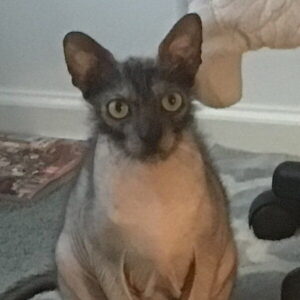 patchy coat that gives this breed its unmistakable “werewolf” look — especially striking around the face, where sparse fur reveals sharp bone structure most cats keep hidden. Despite the wild appearance, Lykoi cats are known for being highly people-oriented and playful. For the full breed rundown, see our Lykoi Cat guide, and if you’re curious where the mutation came from, we cover that in Lykoi Cat Origin: The Real Story Behind the Breed.
Photo: “Cortezmycat.jpg” by Big Slosh, CC BY-SA 4.0, via Wikimedia Commons.
2. Toyger: A Tiger in Miniature
The Toyger was deliberately bred over decades to replicate the bold, flowing stripes of a wild tiger — right down to the circular facial markings — while remaining a fully domestic, affectionate companion cat. It’s one of the newer designer breeds, and the resemblance is genuinely uncanny in good specimens. Read more in our Toyger Cat breed guide, or see how it stacks up against a lookalike in Toyger vs. Bengal: What’s the Difference?
3. Munchkin: The Short-Legged Standout
The Munchkin’s defining trait — dramatically shortened legs from a naturally occurring mutation — makes it one of the most visually recognizable breeds in the world. Despite the compact build, Munchkins are just as active and agile as full-legged cats. For the complete picture, see All About the Munchkin Cat, plus our notes on Munchkin Cat Health if you’re considering one.
4. Manx & Cymric: Born Without a Tail
The Manx carries a naturally occurring mutation that leaves it partially or fully tailless, giving it a rounded, rabbit-like silhouette and a distinctive rolling gait. Its longhaired sibling, the Cymric, carries the same mutation with a fluffier coat. Learn more in All About the Manx Cat and Manx vs. Cymric Cat: What’s the Difference?
5. Exotic Shorthair: The Flat-Faced Teddy Bear
Sometimes called the “lazy man’s Persian,” the Exotic Shorthair has the same doll-like flat face and huge round eyes as a Persian, but in a low-maintenance short coat. The result is a breed that looks almost like a plush toy come to life. Full details in All About the Exotic Shorthair.
What Makes a Breed “Exotic” Anyway?
In the cat world, “exotic” doesn’t have one strict definition — it’s generally used for breeds with a distinctive trait that sets them apart visually or genetically from typical domestic cats, whether that’s a coat mutation, a body shape, or selective breeding toward a wild-animal look. None of the breeds above require exotic-animal permits or specialized care beyond standard cat ownership; they’re all fully domestic breeds, just visually striking ones.
Frequently Asked Questions
Are exotic-looking cat breeds harder to care for?
Generally, no. Breeds like the Lykoi, Toyger, Munchkin, and Manx have unusual appearances but typical domestic-cat care needs. Some, like the Lykoi, may need extra attention to skin care due to their sparse coat, and Munchkins should have their spines monitored, but none require specialized “exotic pet” care.
Are these breeds expensive?
Rarer or newer breeds like the Toyger and Lykoi tend to command higher prices than common breeds due to limited breeding programs and high demand. Munchkins and Manx cats vary more widely depending on lineage and breeder.
Do any of these breeds have known health concerns?
Yes — the Manx carries a risk of Manx syndrome (a spinal condition), and Munchkins should be screened for skeletal issues by reputable breeders. See our dedicated guides linked above for details on each.
Which of these breeds is best for a first-time cat owner?
The Exotic Shorthair and Munchkin are both known for easygoing, affectionate temperaments that suit first-time owners well. The Lykoi and Toyger are also friendly but may be harder to find from a reputable breeder.
Recommended Reading
The Lykoi Cat: Meet the “Werewolf Cat” Breed
2 Responses to 5 Stunning Exotic Cat Breeds You Didn’t Know Existed